
Let’s clear up some things
Firstly, Sciatica isn’t a diagnosis it’s a symptom, so if you’ve been to see your GP with your back pain and leg pain and they’ve told you that you have sciatica, well great, you already knew that, it’s why you went to the GP in the first place. What you need to know is what is causing the pain and how to get rid of it.
Sciatica is a term that is often used incorrectly to explain low back pain with leg pain. Many people who have back and leg pain have been told by their GP or a friend who has experienced similar symptoms that they have sciatica….but is it true sciatica? In our experience, it’s usually not.
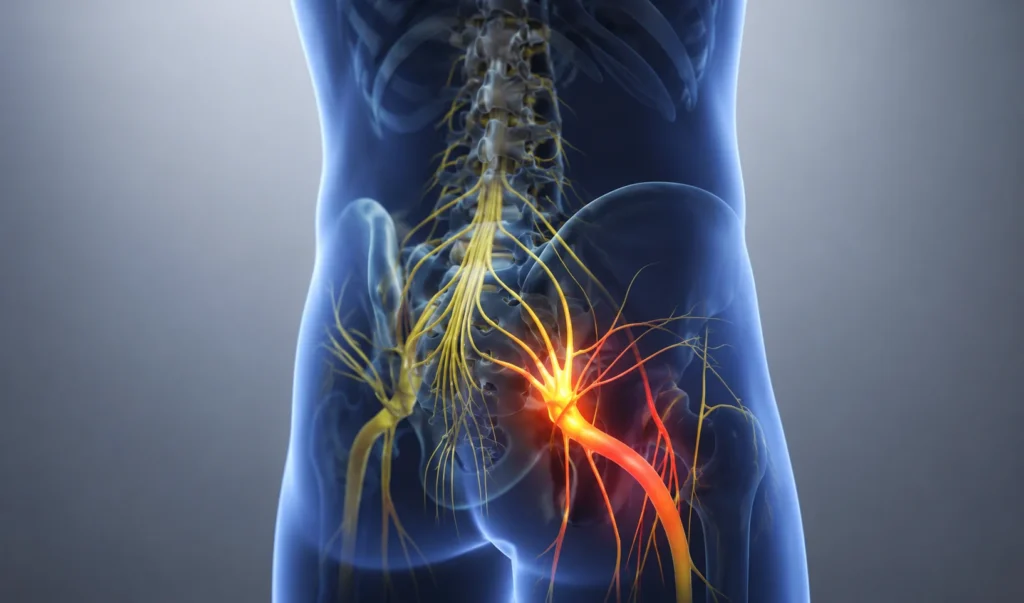
Think of nerve tissue as the spoilt brat of the body. When conditions aren’t just right, your nerves will be the first to flare up and have a hissy fit. The sciatic nerve is the longest and widest nerve in the body; if it’s irritated, you’ll definitely know about it.
What is sciatica really?
True sciatica is caused by pressure on the sciatic nerve at the nerve root as it exits the spine in the lower back.
Everyones experience might be different. Most common symptoms are pain that may be electric and sharp in nature that zips down the back of the leg from the lumbar spine to the foot. It might even make your leg momentarily give way. Burning, tingling, numbness or weakness are all symptoms of nerve irritation.
But just because you have pain that spreads into the leg doesn’t mean you have sciatica.
Muscles are a very much overlooked cause of leg and buttock pain. There are multiple muscles in the lower back and buttocks that can refer pain down the leg. The piriformis and gluteal muscles in particular are very good at mimicking ‘sciatica’ and in my experience, these are the true cause of the buttock and leg pain, not the sciatic nerve.
So is it sciatica, or isn’t it?
1. Did you do anything to suddenly bring about back pain which was then followed by pain spreading into the leg within the week?
3. Does the leg pain go past the knee?
Stretches aren’t a one and done kind of thing; keep going back and doing the same stretches as many times a day as you can, just for a few minutes at a time and the muscles will start to lengthen and relax.
Sciatica and disc injuries
If your think you have injured a disc which may be compressing your sciatic nerve, then I would strongly advise that you visit a Chiropractor or other musculoskeletal specialist. Discs can be tricky and it’s really not worth the risk of further injury by doing the wrong exercises and activities. I haven’t included any exercises here for disc injuries because it’s not something that you should try to diagnose yourself. Not all disc injuries are the same and therefore there isn’t one set of exercises to suit everyone. But I have included top-tips which will help to prevent further injury to your discs, allow you to continue your day and take the edge off while your disc is trying to heal.
Top Tips for looking after your lumbar discs
- Learn to hinge from your hip joints when leaning forward – your hips are ball and socket joints; like your shoulders, they are designed to have a large range of movement, so use them to bend forward so your spine doesn’t have to.
- Lie, don’t sit – Sitting is detrimental to your discs. If you have injured a disc, then sitting for prolonged periods will be uncomfortable. Our advice is to lay down on your back with your knees bent at 45 degrees. Bending the knees decreases the pressure on the discs. If you have injured a disc you will likely feel relief in this position.
- Keep mobile – I know this sounds like something you don’t want to be doing if you have an injured discs because moving around can be painful, but staying mobile is really important. Discs are a very poorly vascularised structure which means that they are bad healers. This is why disc injuries can take so long to go away and why it is so easy to get knocked back to square one – it’s very frustrating. Your discs need you to move so that blood and nutrients needed for the healing process can be pumped into them, this isn’t going to happen if you just stay in bed all day. You’ll want to take things easy but complete rest is going to prolong your discomfort and healing.
- As your pain levels start to reduce, learn to activate your core muscles. Our spines are like a tower that has supports on all 4 sides. Unfortunately for most of us, that support is left to the muscles of the back while the muscles on the front and sides are having a nice long holiday. This is why back pain is so common. There is only so long your back muscles can carry you without the help of other supporting muscle groups.
- Practice maintaining a neutral spine. The spine naturally has lazy S-shaped curves in the neutral position. These are important because this is the position where your spine can optimally absorb forces. If you remove 1 curve (let’s say the lumbar curve) by sitting, then you have taken away your lumbar spine’s ability to absorb the forces; not a great idea, especially if you have already got a lower back injury.